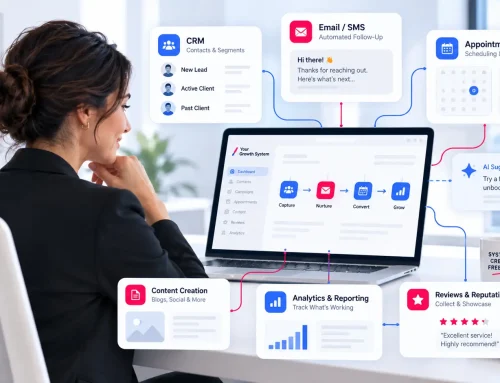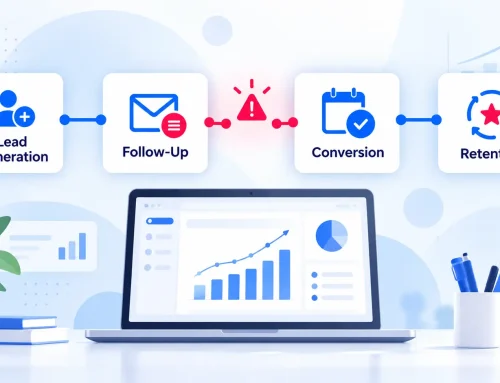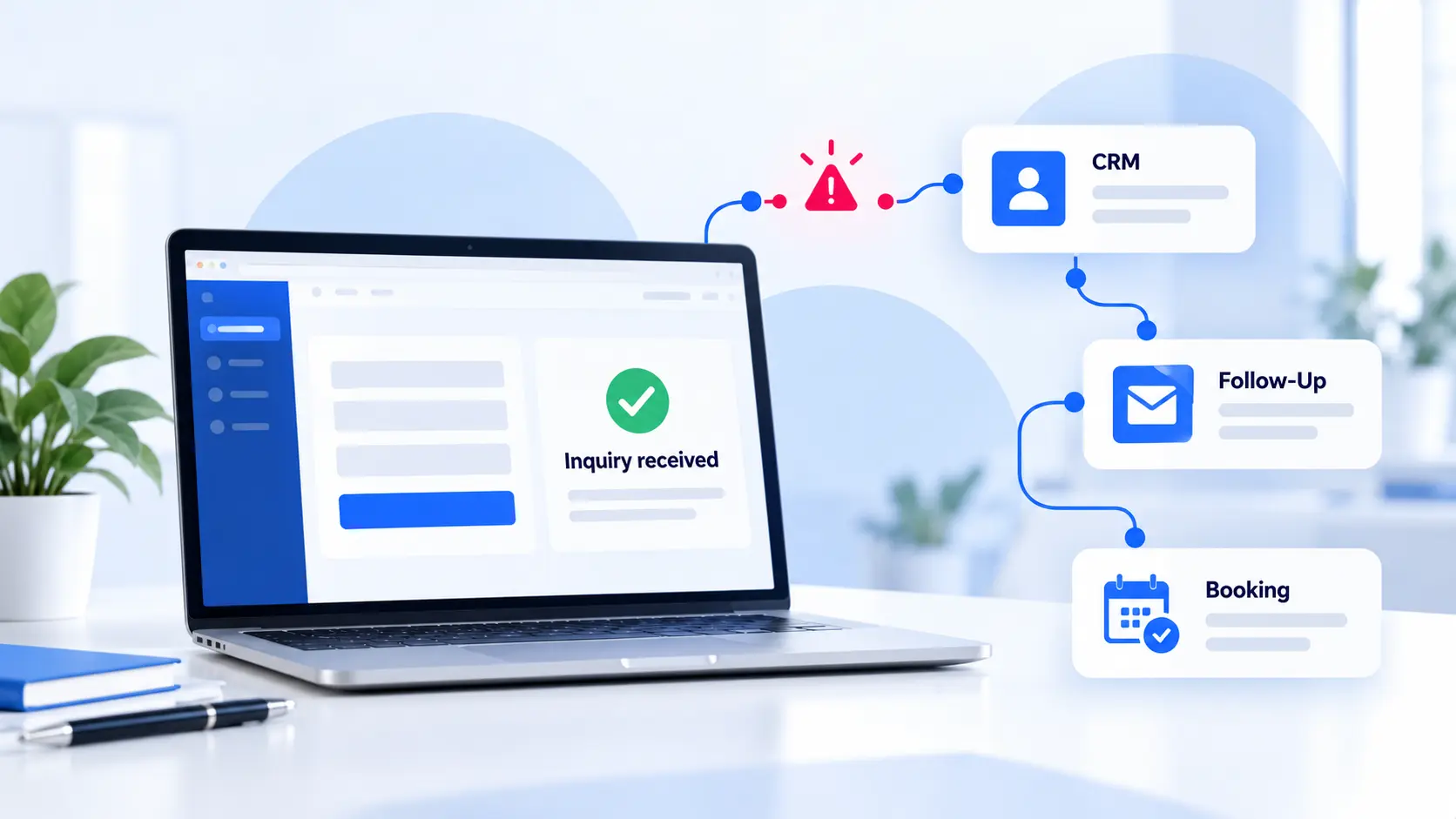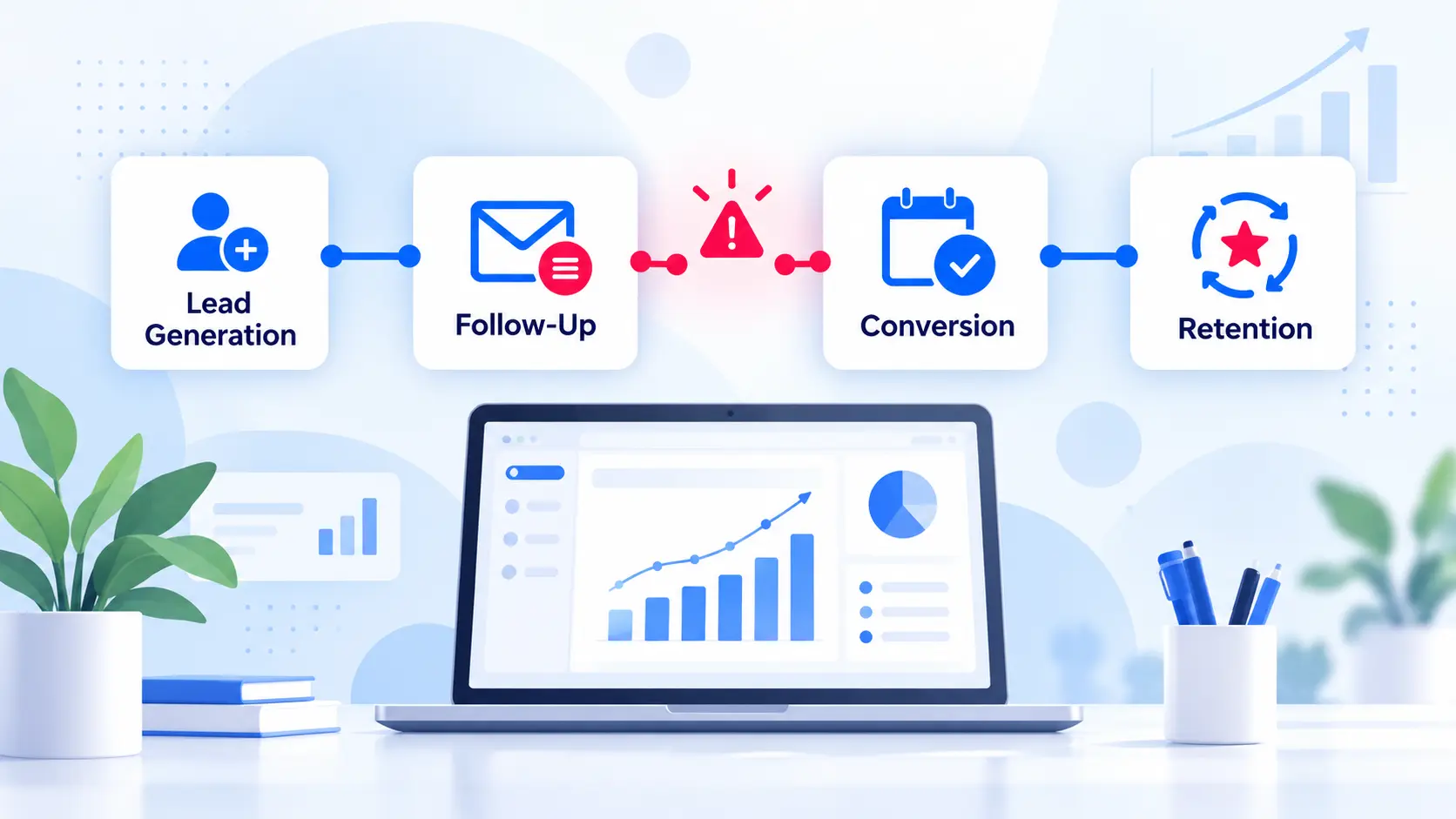
Most service businesses do not have a shortage of marketing activity. They have a coordination problem.
The website may be generating traffic. A contact form may be collecting inquiries. Someone may be publishing content or running ads. Customer information may be stored in a CRM, email platform, spreadsheet, or inbox.
Each piece may be doing something useful. But when those pieces operate separately, opportunities get lost between them.
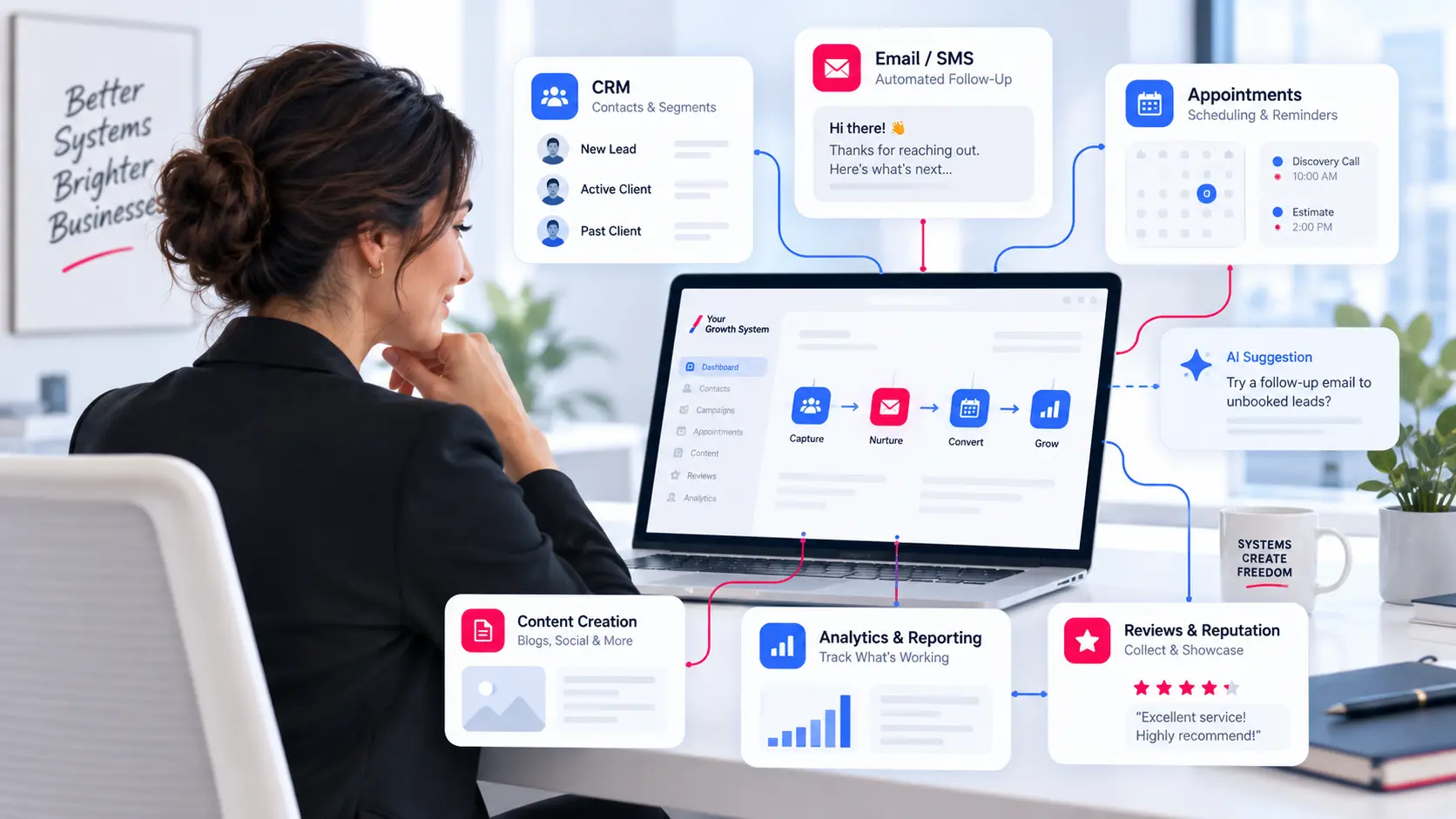
A digital marketing system connects the strategy, messaging, tools, and processes that move someone from discovering your business to becoming a client, returning, leaving a review, or referring someone else.
The goal is not to add more marketing. It is to make the pieces you already have work together.
Key Takeaways
- A collection of marketing tools is not the same as a marketing system.
- Every handoff in the client journey affects lead generation and client retention.
- Strategy, messaging, visibility, websites, CRM, follow-up, and content need to support the same business objectives.
- The most valuable improvement is usually fixing the point where qualified opportunities are being lost.
- Service businesses can build their systems in stages instead of replacing everything at once.
What Is a Digital Marketing System?
A digital marketing system is the connected strategy, infrastructure, and processes a business uses to attract prospective clients, help them take the next step, follow up consistently, and maintain the relationship after the first sale.
It may include:
- Brand positioning and messaging
- Search visibility
- Website and landing pages
- Calls to action, forms, and scheduling
- CRM and pipeline management
- Email and text follow-up
- Content
- Advertising
- Client communication
- Review and referral requests
- Retention and reactivation campaigns
- Reporting and performance measurement
None of these creates a complete system by itself.
A website can generate inquiries without creating a reliable follow-up process. A CRM can store contacts without helping anyone decide what happens next. Advertising can create demand while sending prospective clients into a weak conversion path.
The value comes from connecting each component to the next one.
Where Service Business Marketing Breaks Down
Prospective clients do not experience your website, CRM, content, scheduling, and follow-up as separate marketing channels. They experience one business.
Someone may find you through Google, visit your website, complete a form, receive an email, schedule a conversation, become a client, and eventually leave a review.
Every handoff affects what happens next.
Common breakdowns include:
- Search traffic reaching a website with unclear messaging
- Visitors being given too many competing next steps
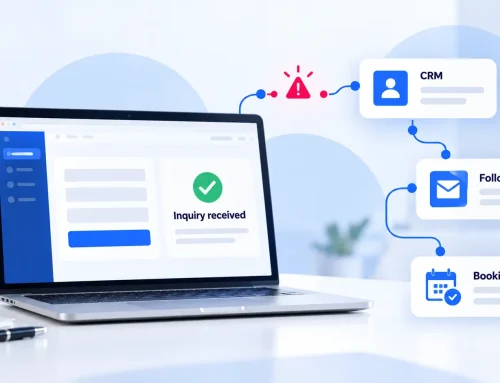
- Contact forms sending an email without creating a CRM record
- Calls and inquiries not being tracked consistently
- Slow or inconsistent follow-up
- Prospective clients disappearing after an initial conversation
- Estimates or proposals receiving no defined follow-up
- Client information being scattered across platforms
- Review requests depending on someone remembering to ask
- Past clients receiving no continued communication
- Marketing reports that do not connect activity to clients or revenue
Adding another tactic rarely repairs these handoffs.
The better approach is to identify where the current system is losing qualified opportunities and strengthen that connection first.
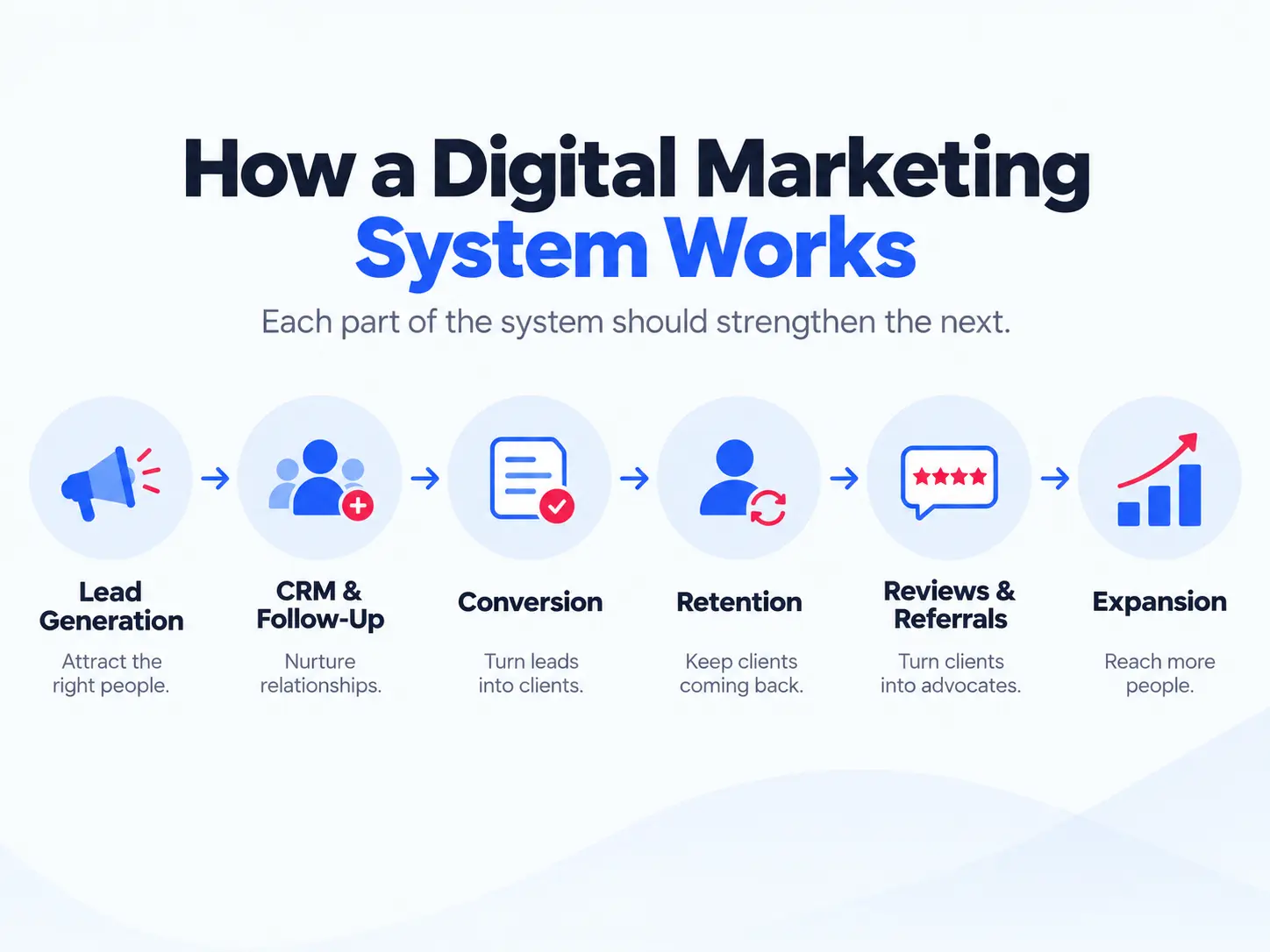
The Six Elements of a Connected Marketing System
At Rosetta Marketing Designs, we organize this work around six System Elements. They are not a fixed package that every business must purchase. They provide a practical way to determine what is already working, what is missing, and what should happen next.
1. Strategy & Implementation
Strategy & Implementation establishes the business objective, identifies the most important constraint, and determines the right sequence of work.
Without that direction, businesses often add websites, software, campaigns, and content without addressing the problem limiting growth.
A useful strategy answers:
- What business result are we trying to improve?
- Where is the current client journey breaking down?
- Which change would have the greatest impact?
- What should happen now, and what can wait?
- Who is responsible for implementation?
- How will we know whether the change worked?
Strategy creates direction. Implementation turns that direction into an operating system.
2. Branding & Messaging
Branding & Messaging helps the right people understand what the business offers, who it serves, why it is different, and what they should do next.
This goes beyond visual identity.
The message must remain clear across search results, the website, advertising, content, forms, emails, and sales conversations. If each channel describes the business differently, the client journey becomes harder to follow.
Clear messaging improves every other part of the system because it gives prospective clients a consistent reason to continue.
3. Web Design & Hosting
The website is often the central point between visibility and action.
Web Design & Hosting should support a clear path from the question that brought someone to the site to the next appropriate step.
That requires more than an attractive layout. The site needs:
- Clear positioning
- Useful page structure
- Mobile usability
- Focused calls to action
- Reliable forms and scheduling
- Strong connections to the CRM and follow-up process
- Stable hosting and ongoing maintenance
Traffic has limited business value if the website does not help qualified visitors move forward.
4. SEO & Visibility
SEO & Visibility helps prospective clients find the business when they are looking for relevant information, services, or solutions.
That can include:
- Search engine optimization
- Google Business Profile
- Local and broader search visibility
- Reputation and reviews
- Website content
- Search-focused service pages
The goal is not traffic for its own sake. The goal is visibility with people who are reasonably likely to become good clients.
Reviews also contribute to visibility by giving prospective clients evidence that the business delivers what it promises.
5. CRM & Follow-Up
CRM & Follow-Up connects an inquiry to a defined next step.
Instead of contacts being scattered across inboxes, phones, calendars, forms, and spreadsheets, the business gains one place to understand where each relationship stands.
A connected CRM and follow-up process can support:
- Immediate inquiry confirmation
- Team notifications
- Pipeline tracking
- Consultation or appointment reminders
- Missed-call responses
- Estimate and proposal follow-up
- Longer-term nurturing
- Client communication
- Review requests
- Retention and reactivation
Automation should support personal relationships, not replace them. Its role is to make sure important communication happens consistently.
6. Content Marketing
Content Marketing gives prospective clients useful information before they are ready to speak with someone.
Effective content can:
- Answer common questions
- Clarify how a service works
- Address concerns that delay a decision
- Demonstrate expertise and judgment
- Support search visibility
- Give the business something useful to share during outreach
- Continue educating prospective and existing clients
Content performs best when it serves a defined role in the larger system. Publishing without a clear audience, purpose, or next step creates more activity without necessarily creating more business.
How the System Supports the Client Journey
The six System Elements work together around the client journey.
A prospective client first needs to discover the business. SEO, content, advertising, referrals, reviews, and partnerships can create that visibility.
They then need to understand the business. Positioning, messaging, and the website help them decide whether the service appears relevant and trustworthy.
Next, they need a clear way to act. A phone number, form, booking tool, or other call to action should make the next step obvious.
Once they respond, the CRM and follow-up process should capture the opportunity, organize the information, and support a timely response.
After someone becomes a client, continued communication, reminders, useful content, review requests, and reactivation campaigns help protect and strengthen the relationship.
The complete path looks something like this:
Discovery → Understanding → Action → Follow-Up → Decision → Client Experience → Retention → Reviews and Referrals
A weakness at any stage affects the stages that follow.
More traffic will not solve slow follow-up. A sophisticated CRM will not fix unclear messaging. Automated review requests cannot compensate for a poor client experience.
Each component has a job, but the connections create the result.
What Should You Fix First?
A service business rarely needs every possible marketing component at the same time.
The right starting point depends on where the current system is losing the most value.
Begin by asking:
- Are enough qualified prospective clients finding the business?
- Do they understand why the business is relevant to them?
- Does the website provide a clear next step?
- Are inquiries captured and answered consistently?
- Can the team see where each opportunity stands?
- Are qualified opportunities becoming clients?
- Does communication continue after the first sale?
- Are reviews, referrals, repeat business, and reactivation built into the process?
- Can marketing activity be connected to business results?
The answers reveal whether the priority is visibility, messaging, the website, follow-up, conversion, retention, or the coordination between them.
Start with the highest-impact gap. Use the tools and assets already available when possible. Measure what changes. Then strengthen the next part of the system.
That creates steady improvement without turning the business upside down or adding technology it does not need.
Frequently Asked Questions
Make the Marketing You Already Have Work Together
Your strategy, messaging, website, visibility, CRM, follow-up, content, reviews, and client communication all influence growth.
They should support the same client journey.
Rosetta Marketing Designs starts with what your business already has, identifies where opportunities are being lost, and strengthens the parts of the system that matter most.